
To the Past: Material Objects and the Imagination
Authored by UMIH Intern Patrick Fermin

Roman Coin Carausius radiate PAX AVGGG London RIC 118. Source: Wikimedia Commons.
How do artifacts allow us to peer into the past? What kind of processes can our minds conjure up when we are holding materials from history? These questions were answered by Dr. Christoph Heyl in his presentation, “The Closest Thing to Time Travel: Original Antique Objects as a Teaching Aid in Literary Studies.” Heyl discussed his use of historical artifacts in his pedagogy to connect students to the past. Posited in the title of his presentation, engaging with material objects allow us to travel back in time, forcing questions to arise about how people lived. Exploring the British Museum and markets at a young age informed his fascination with artifacts. Through specific material examples, Heyl showed what kind of objects he uses, how he deploys them, and what kind of understandings occur from this.
Although Heyl introduced many materials which aid his teaching, there were a few that I found myself particularly fascinated in. His introduction of a Roman coin that was minted in London was incredibly revelatory in both the history of London and England at large. It informs us about the reach of the Roman Empire from the Persian Gulf to Britain, illuminating just how large and encompassing this empire was. In the more local imagination, what did the coin purchase in Roman Britain? What did markets look like? What kind of goods was the coin worth? Finally, the human aspect also appears in the coin that have survived through time. The hands that have touched and traded the coin between one another, and the conversations that may have occurred as people purchased food or materials. Just from a coin from the past, one’s imagination is ignited and transported back into the past.
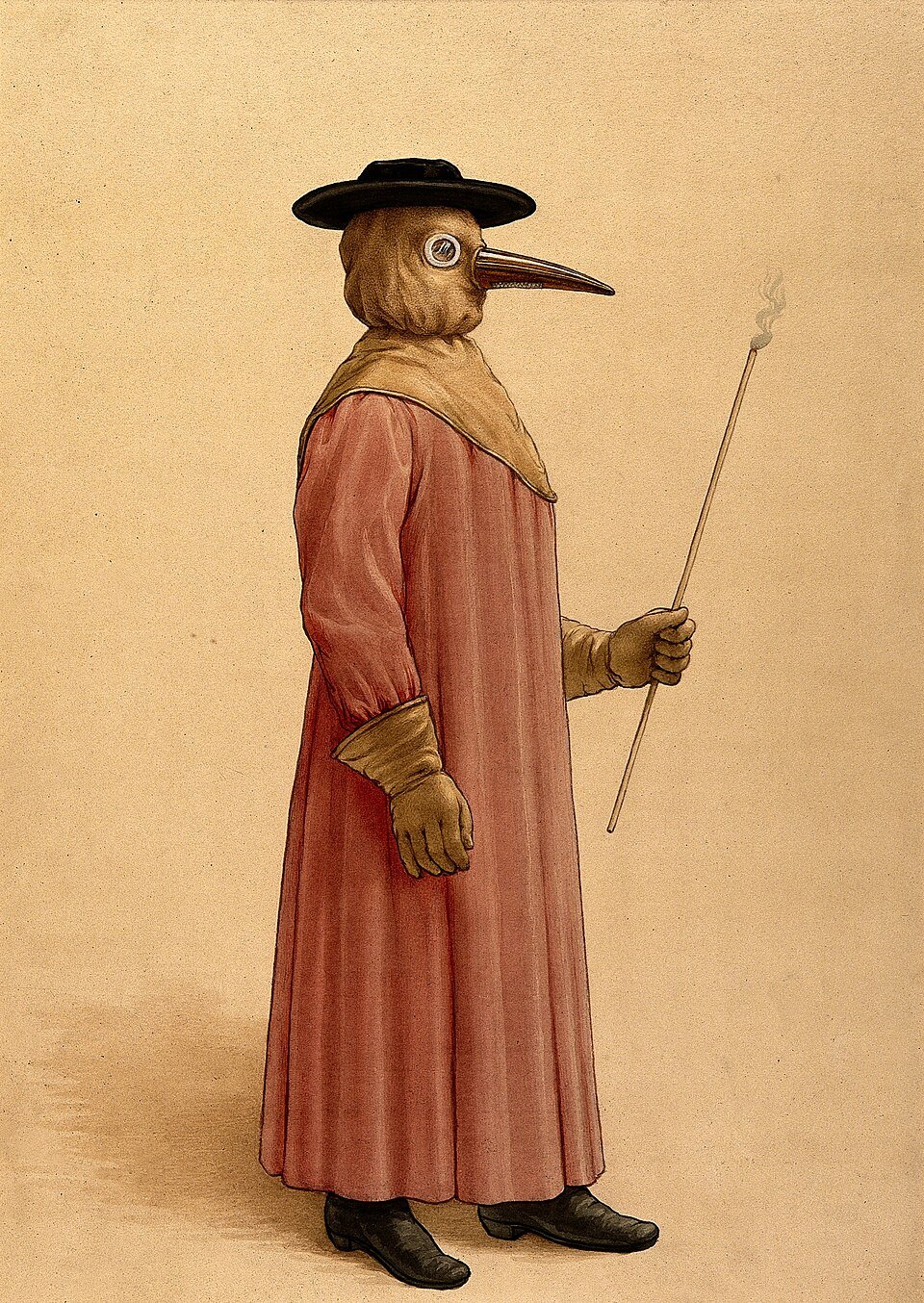
A physician wearing a seventeenth century plague preventive. Source: Wikimedia Commons.
Heyl’s presentation of a clay pipe brought us to the Great Plague of the late-seventeenth century. Found in Central London, the clay pipe was used to ward off the plague through smoking a bit of tobacco. The prevalence of smoking tobacco during the plague led to the normalization of smoking. This can be found in the diary of Samuel Peeps, who according to Heyl, denoted how tobacco could get rid of the plague. The smoking of tobacco would become a “memento mori,” and even to the present, linked with death. Apart from the urban location in which the artifact was found, it was in the ground’s fire layer indicating the Great Fire of London. Where the artifact was found, both within present London and in ground, and its use during the plague remind us of destructive forces beyond our control. The clay pipe forces us to recognize the volatility of the past, and how humans have come to cope and deal with such volatility.
Dr. Christoph Heyl’s presentation was ultimately informative in how we can engage with the past through material objects. Transporting our imaginations to how people lived and dealt with destruction connects us with the souls of lived experiences throughout history. The currency of Roman London, and the use of tobacco clay pipes during the Great Plague both reveal different histories of London. Through artifacts we can see and/or feel the impact of material objects in people’s lives, and even our own.