
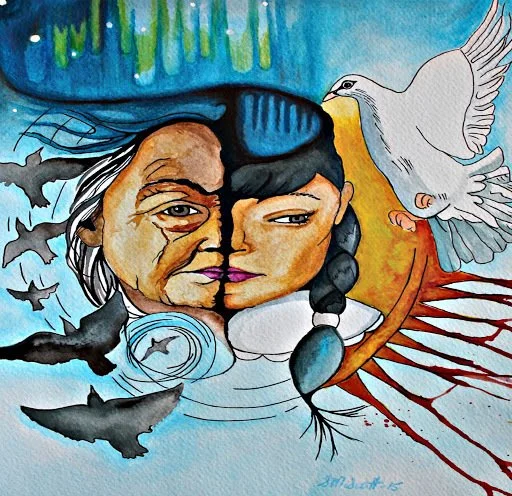
The cover art of the Cree edition of Rosanna Deerchild’s anthology Calling Down the Sky, also titled î-nitotamahk kîsik.
Written and published by Abbey Fedora (Department of English, Theatre, Film & Media), UMIH Undergraduate Intern.
“This is my memoir,” said Rosanna Deerchild after reading a collection of carefully curated poems from her publications to the eager audience. On Tuesday, November 3rd, the UMIH Research Cluster Poetry, Grief, and Mourning welcomed award-winning poet, playwright, and journalist Rosanna Deerchild to the University of Manitoba to share a selection of her poems and insights about her creative process. Drawing on the importance of speech, a theme that is interwoven throughout Deerchild’s poems, Deerchild recited her poetry to the audience, an experience that exemplified the power of voice.
Before Deerchild’s readings, University of Manitoba’s Dr. Jamie Paris gave an introduction about the role of poetry in times of grief. Paris introduced the Research Cluster project “There Are (No) Words: Poetry, Grief, and Mourning” and discussed the meaning behind this title. Paris explained that the Cluster is dedicated to exploring what it means to write poetry about experiences that feel inexpressible, arguing that contrary to common sayings like “there are no words,” there are words to describe grief, and effective ones at that. Paris elaborated that mourning language is often situated in the past. Rather, the Cluster argues that living poets continue to speak about these experiences. Paris further argued that reconciliation is “occurring here now,” and not somewhere in the future.
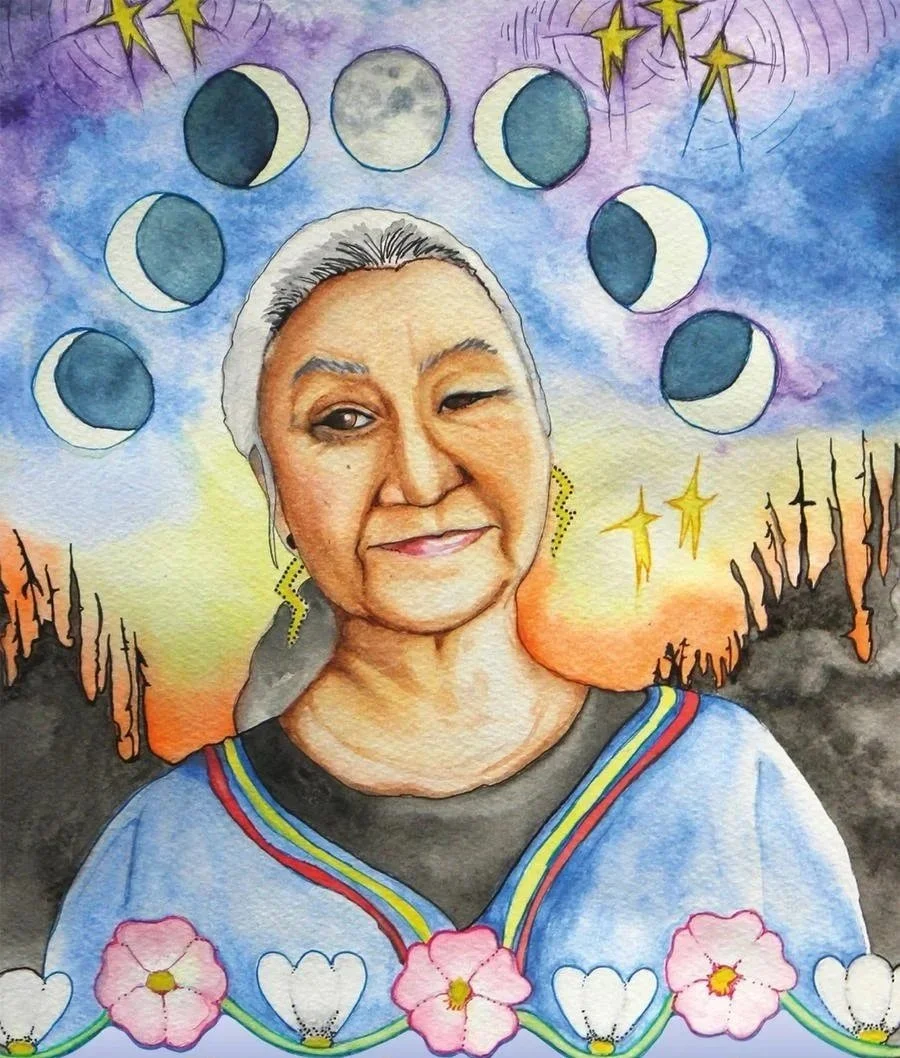
The cover image of Rosanna Deerchild’s Calling Down the Sky (î-nîhci-tîpwâtamân kîsik) which features a painting of her mother.
Deerchild began by reading from her anthology Calling Down the Sky (î-nîhci-tîpwâtamân kîsik), which Deerchild shared was inspired by her discovery about her mother’s experiences at residential school. The poems Deerchild chose to recite from this collection are united by their themes of speech and its restriction; referencing the prohibition of Indigenous languages in Canada’s residential school systems, Deerchild focuses on the role of speech in identity and communication. In her poem “mama’s testament: truth and reconciliation,” Deerchild writes, in the voice of her mother, “share your story / as if it’s that easy,” proposing the unspeakable nature of genocidal pain (24-5). In this poem, Deerchild explicitly depicts speech as something that is limited by trauma while actively using it to navigate said trauma. Similarly, in “things i know about my mother as a child,” Deerchild writes that saying “i love you” is “a rare gift just for birthdays,” framing speech as something difficult to acquire, aligning with the metaphor of a gift as something given (12, 13). Deerchild further attributes a sense of mysticism to the act of speech through assigning it to a holiday. Deerchild concludes this poem by writing “mama drinks to forget / something she does not name” near its end (25-6). In this solemn conclusion, Deerchild reiterates the loss of speech as a result of trauma while also demonstrating its potential effectiveness through referencing the power of naming.

Madeline Schroeder, Untitled.
Deerchild explores speech in a similar way in “over tea,” where she writes, about her mother’s tea, that “the heat burns her tongue,” focusing on the mouth as the site of trauma (25). Deerchild explained that this poem discusses the time she learned about her mother’s experiences over tea. Suggesting a sense of hesitancy towards the act of speaking through emulating a burning sensation on the tongue, Deerchild again frames a loss of speech as the result of colonial violence. While Deerchild focalizes the pain of speech in this poem, she emphasizes its continuation, framing speech as an act of perseverance. Deerchild demonstrates this notion by including song in her poetry; when recited aloud, these musical moments become an example of exemplary vocal power. Deerchild’s musical recitation was a captivating moment for all those in attendance. When asked why she chose to incorporate song into her poetry, she explained that music had “naturally weaved its way into my work,” creating a beautiful image of how voice is inherently powerful.
During the question period, Deerchild was asked why she chose poetry as her primary medium of expression. She responded that “it has always been the form of ceremony for me,” explaining that she continues to use her voice in response to the language that has been taken. In both the words that she writes and the ways she recites them, Deerchild’s work continues to demonstrate the importance of speaking. Focalizing Indigenous experiences in her poems, Deerchild’s work emphasizes the power of speech in acts of resistance and reconciliation.

A special thank you to Rosanna Deerchild for sharing and discussing her work with us so thoughtfully and vulnerably. You can find select publications by Deerchild for sale at McNally Robinson or GoodMinds.