
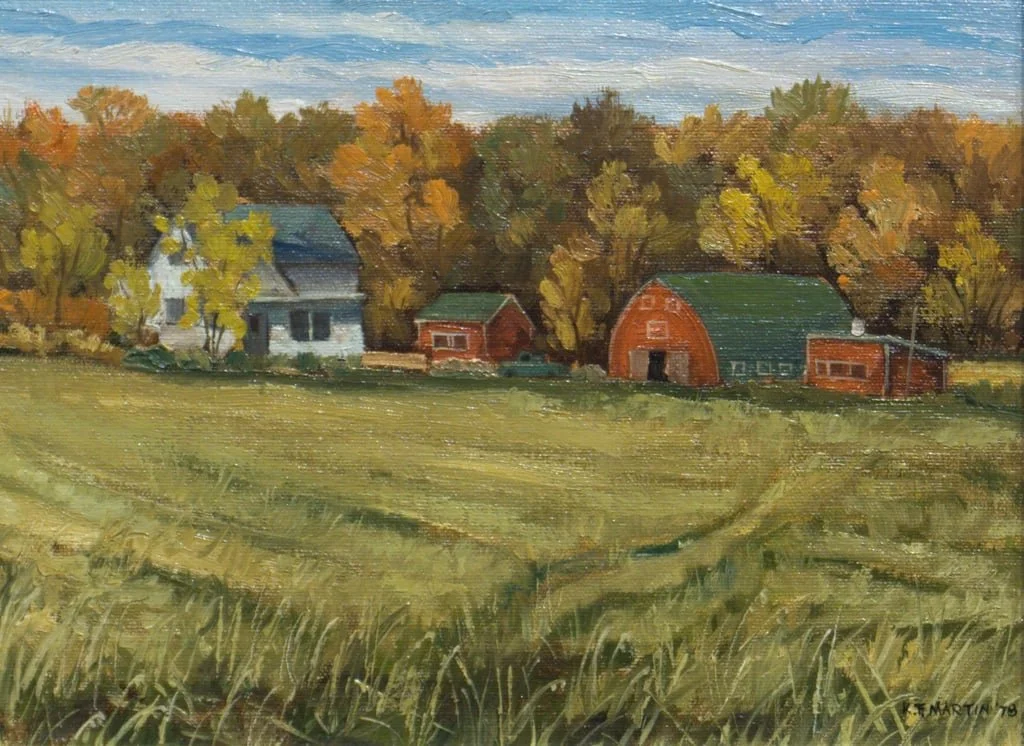
Kenneth Martin, Manitoba Farm, 1978.
Written and published by Abbey Fedora (Department of English, Theatre, Film & Media), UMIH Undergraduate Intern.
In her presentation “Oral Histories of Identity Formation and Collective Memory in Low German Mennonites of Southwestern Ontario,” Brennen Siemens, UMIH Graduate Fellow, shared her insights and future research plans for her thesis to the room of attendees. On Friday, October 30th, Siemens discussed Mennonite societies, their prevalence in Canada, and the structures of their communities. Focusing on oral history and the ways that verbal communication perpetuates values, Siemens explored how Mennonites rely on speech to maintain community.
Siemens began her presentation by informing the audience about Mennonite history. Siemens explained that, in general, Mennonites are a religious community that prioritizes pacifism, modesty, and separation from the secular world. While Siemens noted that these beliefs are a common thread across Mennonite communities, she emphasized that Mennonites branch off into many different variations. Siemens’ project focuses on a group called Low German Mennonites, a transnational group that had several waves of mass migration, many of which landed in Canada. The name “Low German” is derived from their residence in the lowlands of Germany. While many Low German Mennonite communities claim to have immigrated due to religious persecution, which Siemens confirmed was certainly a factor, she explained that the economic benefits are often excluded from the Mennonite narrative, which, instead, prioritizes suffering. Siemens attributes the reason for this forgotten narrative to the oral transmissions of history in Mennonite communities.

Rembrandt van Rijn, The Mennonite Preacher Anslo and his Wife, 1641.
Before diving deeper into her findings, Siemens shared her methodologies. Aligning with Mennonite values of oral history, Siemens conducted the majority of her research through interviews. Siemens explained that she chose this method because there is a lack of historical documentation in and about Low German Mennonite communities, due to lower literacy levels as well as a prioritization of the spoken word, perhaps in an attempt to preserve exclusivity. Siemens explained that the prioritization of the spoken word helps Mennonites form communities based on shared beliefs; this sense of sameness and “continuity,” as Siemens called it, is built by the sharing and repeating of histories learned through word-of-mouth. Siemens elaborated that this method of communication creates a “unique nation-like identity that is rooted in collective memory,” which both reinforces Mennonite values as well as the community’s understanding of them.
Siemens’ findings focused on education, the concept of the home, and politics. Regarding education, Siemens explained that Low German Mennonites mostly attend public schools, private Christian schools, and homeschools. While some attend public schools, Siemens explained that these students are often ostracized or separated from non-Mennonite students due to parental complaints about the “worldly” curriculum. Children who are removed are often placed in alternative forms of schooling that allow them to obtain a high school diploma while developing farming or industrial skills. Siemens elaborated that removal from public schools contributes to lower literacy rates and situates learning in the home, an important space in Low German Mennonite identities. Siemens noted that the home is where one learns not only what it means to be Mennonite, through food and daily activities, but also where one enacts this identity. Siemens locates the home as the primary place where personhood is formed; here, children learn the “narrowly defined” roles of gender and hierarchy as well as community beliefs through observation and participation.
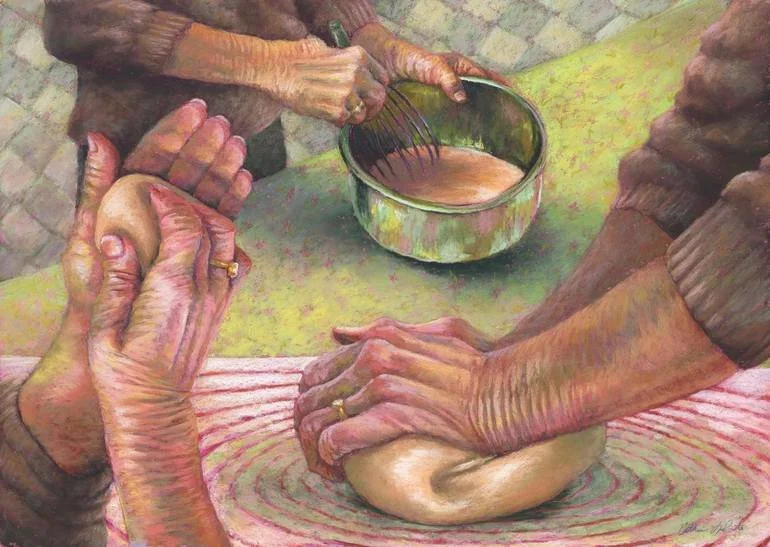
Catherine Lapointevollmer, Baking Day With Grandma Pastel Painting of Hands.
Low German Mennonites value private learning and experiences in the home and community; these ideals are challenged by their engagement in politics. Earlier in her presentation, Siemens noted that Low German Mennonites believe they should be “in the world, but not of the world,” meaning they should refrain from engaging with wider society. This separation is established through secluded living, a lack of engagement with technology, and visual markers such as modest dress. While Siemens noted that many Low German Mennonites do participate in politics through voting, temporarily engaging with the worldly sphere, she explained that many opt to pray for election results, participating while maintaining this separation. This partial participation places many Mennonites in a liminal position: between active and passive participation in wider society. Siemens curated a similar experience of this liminality for her attendees, who were drawn into the workings of exclusive Mennonite societies through her talk. Modelling the aforementioned importance of oral history in Low German Mennonite societies that Siemens highlighted throughout her presentation, Siemens’ fascinating research, as well as her thorough delivery of it during her talk, effectively demonstrated the ways in which knowledge is transferred through speech.
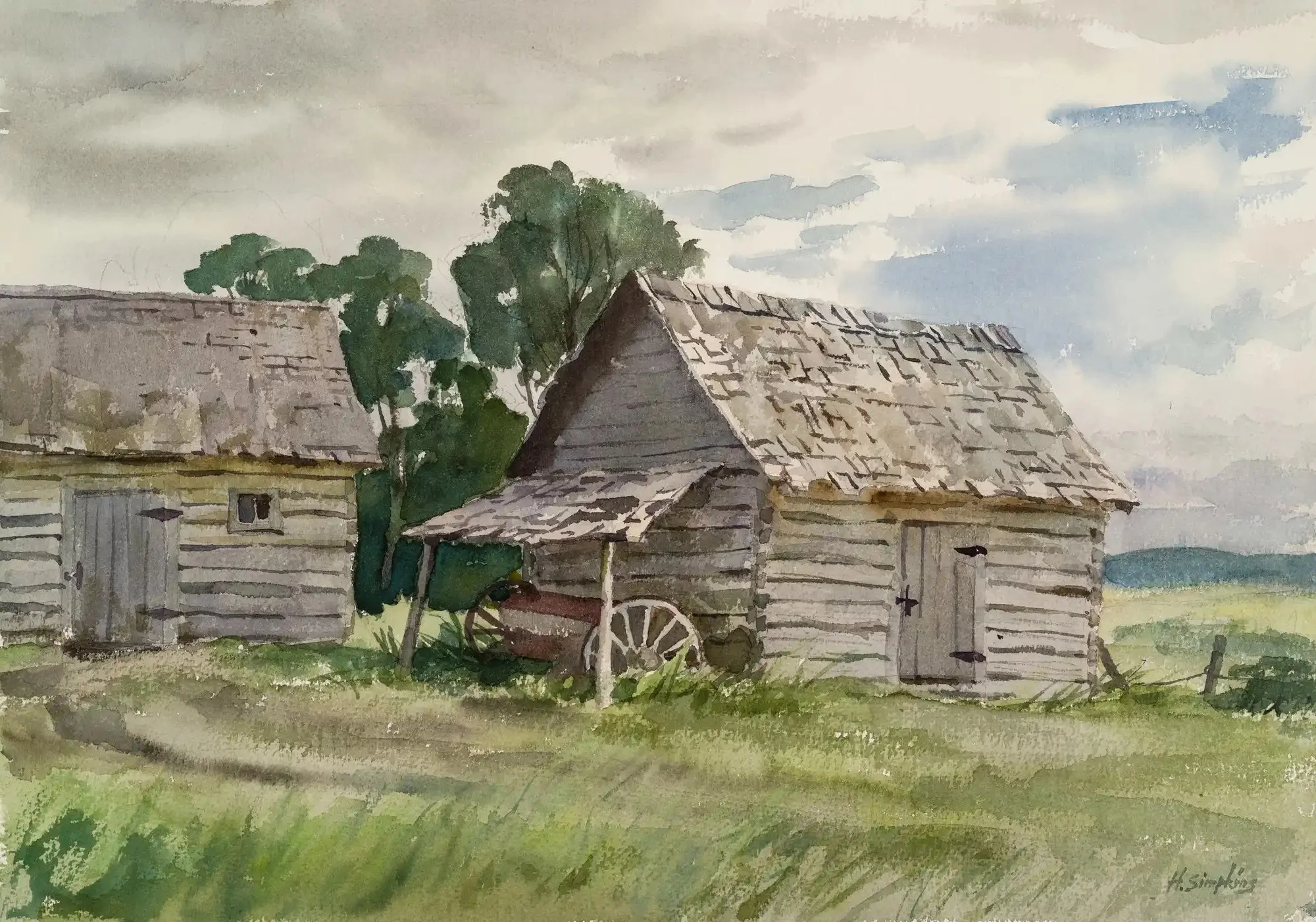
Henry J. Simpkins, Birds Hill (Manitoba).