
Authored by UMIH Intern Emma Sciarretta
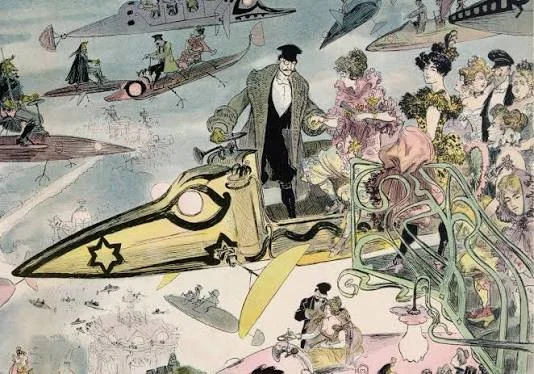
La sortie de l’opéra en l'an 2000, Albert Robida (ca. 1902)
“What does the term ‘space opera’ bring to mind for you?” Dr. Jes Battis asked the audience during their presentation “Queer and Trans Space Operas: From Samuel Delany to Becky Chambers,” on October 26. The audience was quick to suggest classic films and series such as Star Wars, Star Trek, and Battlestar Galactica, or even video games like Space Invader, all of which exemplify the vast landscape that is science fiction. “Space Opera” was a pejorative term coined by W. Tucker in a magazine called Zombie: “for the hacky, grinding, stinking, outworn spaceship yarn, we offer space opera” (1941). Battis suggested that the concept creates a love-hate relationship with space operas as audiences try to determine the significance of campy writing.
In science fiction and fantasy as genres, Battis asserted that there is too much emphasis on structures and terminology. They noted that in the 1960s Samuel Delany wrote queer characters and viewed science fiction as cruising and traversing through dangerous spaces. Becky Chambers’s Wayfarers series has been called “cozy” science fiction, a term she resents for suggesting that her stories are low stakes and repetitive. However, her books are considered “cozy” because they are relational. Battis said there is a tension in science fiction between stories that focus on the technical and those that focus on relationships, but they both demonstrate different conceptualizations of science fiction. Contrasting views on terminology also generated dialog with the audience regarding the terms science, fiction, and fantasy, and their relative relevance for defining the science fiction genre.
Building upon the ontological discussion of what constitutes science fiction, Battis then posed the question, “what would happen if we let genres dissolve into one another?” While some members of the audience said that it would make it difficult to distinguish and organize writing styles and topics in bookstores, others suggested that perhaps people would be more open to reading something they originally would not have. If genres dissolved, it would mean expanding our view of what science fiction typically entails. Battis also asked the audience, “what if space did not define science fiction, and what might stories look like if they were not set in space?” As a setting, space foregrounds an emptiness which allows for endless potential; if science fiction was set on earth, it might be too real, displacing it from what is expected of science fiction. However, Battis emphasized that this may be exactly what is needed in today’s publishing world.
The term “space opera” almost immediately evokes the idea of space travel; Battis encouraged the audience to think about what wandering, wayfaring, meandering, or transformation can means in science fiction. In the context of television series, Battis compared serial narratives to standalone episodes; they indicated how divergence, thus meandering, from main story arcs allows for play that makes standalone episodes more interesting and memorable. However, viewers and readers still expect a sort of reader-writer contract.
Genres are distinct so that readers can make sense of them; excessive labelling creates expectations for what a person is about to read, and when they want to find something similar, they seek out the same genre. Yet Battis states that genres constrain people from exploring new topics. There is value in meandering, thus genres perhaps should dissolve into one another, for categories are artificial and it can be interesting to deconstruct them. As we continue to develop our understanding “space operas” we can also consider how, according to Battis, “science fiction is a moving target.” While it is a genre that has significant space for expansion and variety, it also positions events as taking place in the distant future, when their beginning may be happening now.