
Learning to Love the “Irk”: Cinematic Motus in the Horror Genre
Authored by Indiana M. A. Humniski
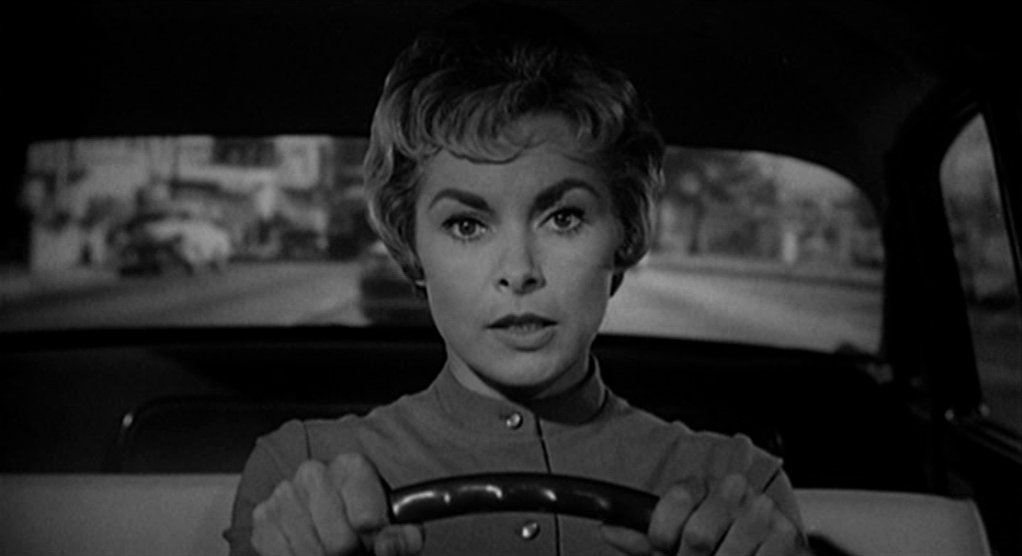
Still from Alfred Hitchcock’s Psycho (1960).
While watching Alfred Hitchcock’s Psycho on film, UMIH Graduate Fellow G. G. Dascal (they/them) began to ponder the value of cinematography in the horror genre.
I must admit, when they mentioned how one of the film’s scenes reminded them of the splatter-forward art style of Jackson Pollock, I assumed we would be visiting the iconically bloody shower sequence. Like a redirected jumpscare, Dascal instead pointed to a scene near the beginning where Janet Leigh is driving towards the much-known (and much-feared) Bates Motel. Her windshield is pelted by pouring rain that reflects the “excitement, fear, and doubts” that Dascal describes the protagonist as feeling during this exposition. Interestingly, Dascal informed us that this scene differs from the rest of the movie stylistically. Still, the abstract cinematography sparks a Marie-Kondo-esque “joy” within Dascal. They explained, with a brilliant smile, that “for these shots, I didn’t have to think about meaning; I just had to feel.”
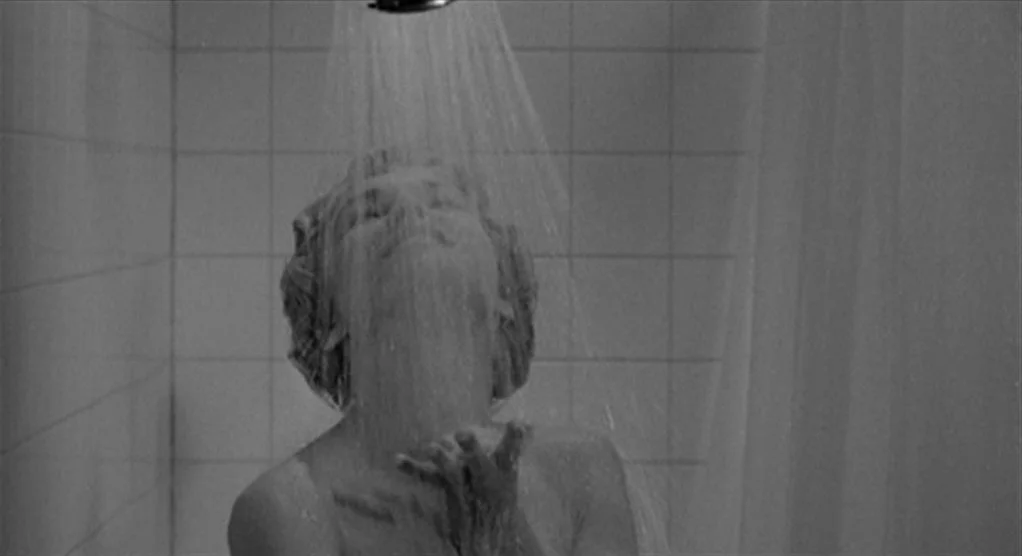
A still taken from Hitchcock’s iconic shower scene in the film where cleanly bliss quickly turns into bloodcurdling terror; the scene’s inclusion of pouring water interestingly echoes Dascal’s highlighted scene of driving in the rain.
So, what does it mean to feel “joy” in horror? Perhaps, it simply means to be moved. Dascal’s focus on “motus” – from the Latin “movere” (movement) – asks viewers to question the ways that the media that they feast upon figuratively chews them up in return. Dascal states how “the things that move us inside, they transform us inside”. Transformation is a much-depicted generic convention in horror media. So, much like the metamorphosizing narratives in the genre, we – as viewers of horror – seemingly morph alongside the protagonists of these films.
In effect, we become like Gregor Samsa waking up as a cockroach (Kafka 1915), like Jeff Goldblum molting into a fly (Cronenberg 1986), or – moving away from these insect interlinks – like Dr. Jekyll consuming a chemical mixture to become the violent form of Mr. Hyde (Stevenson 1886). My love for classic literature and my current seminar, “Frankenstein’s Monsters” with Dr. Michelle Faubert, certainly prompted that last example. In any (strange) case, Dascal proposes that we are moved by movies and thus, stand up as an altered version of our pre-watch selves after the screen goes dark. For self-proclaimed “gorehounds” like Dascal, this transformation may be more permanent and, further, may become established in long-term projects like their larger thesis.
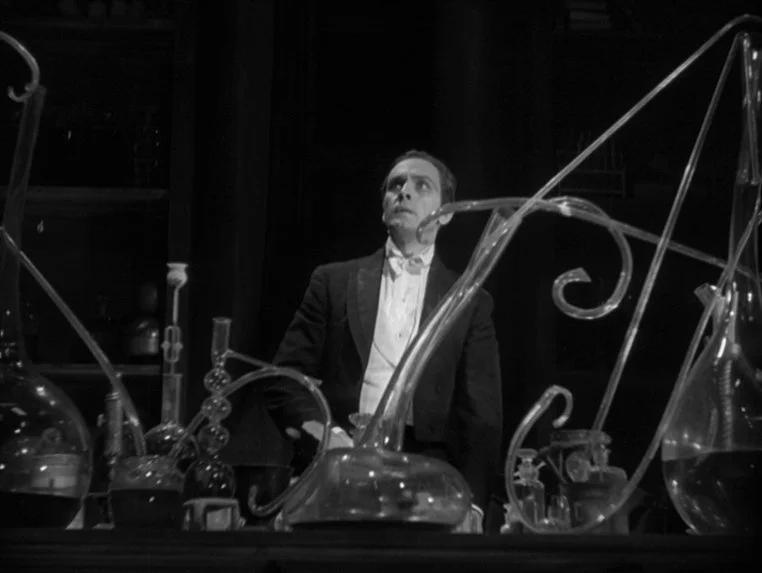
Dr. Jekyll (portrayed by Fredric March) in Rouben Mamoulian’s well-known yet problematic adaptation of Dr. Jekyll and Mr. Hyde (1931)
As one of Dascal’s cited academics, Noël Carroll, asserts, there is an inherent paradox in appreciating horror; as Dascal jokingly summarizes, “how can you love something that makes you irk?”. Perhaps, instead of shying away from this feeling, it is time to lean into the “irk” and examine – not exactly the popcorn-tossing reactions of viewers – but rather, the triggers that the genre employs to glean these reactions. Keeping with the eerie vibe of their presentation, I wonder if Dascal wishes for readers of their thesis to metaphorically trace the individual silk strands of a spiderweb rather than the interconnected spectacle as a whole. That said, let’s take a peek at some of these strands now:
Dascal’s thesis ranges from low to high brow horror, with their slides sliding from zombified monkey-mommy issues (Peter Jackson’s Braindead) to “beautiful, bloody bodies” (David Argento’s Deep Red). While Dascal warns against the new-age promotion of “elevated” horror, the expanse of films that they reference throughout adds both depth and breadth to their overall project. In this sense, Dascal captures a plethora of genre-based examples as varied as the gruesome deaths featured in the film series, Final Destination (2000-). In their thesis, Dascal proposes five major categories of cinematic motus (defined by Dascal in the quotation marks) that repeatedly pepper the genre:
Allegorical Motus: “Shots that make the viewer connect a series of visual signs to form a relevant signifier alluding to the themes explored within a film.”
Narrative Motus: “Shots which showcase the culmination of important narrative actions, highlighting the work established by the plot, dialogue, and story structure for a satisfying resolve.”
Shock Motus: “Shots are edited and positioned within the visual narrative as distinctively surprising, offering a rupture from the expected. Through different kinds of build-ups, the shock motus plays a game of tension and release with an aesthetically impactful climax.”
Reflexive Motus: “Shots that willingly make the viewers aware of the fabric of cinema as a medium, letting them peek at the actual conditions of film production through specific camera work, filmmaking imagery, and metatextuality.”
Liminal Motus: “Shots in which the viewer is unable or has trouble understanding what is exactly being shown. In the case of a location (a “liminal place”), viewers cannot make out where the characters are or what the place consists of. In the case of an abstract image, viewers struggle to comprehend what is being filmed.”
Over these five segments, Dascal made good upon their earlier promise to the room of attendees as they proclaimed, “this will be the goriest slideshow that you’ve ever seen!” From chainsaw-split noses to staticky found-footage, the horror genre is certainly something that leaves a lasting impact on viewers everywhere – an impact that Dascal successfully argues is as physically transformative as it is emotionally stimulating.