
“(Write it!)”: Exploring Grief through Poetry with Dr. Neil Besner
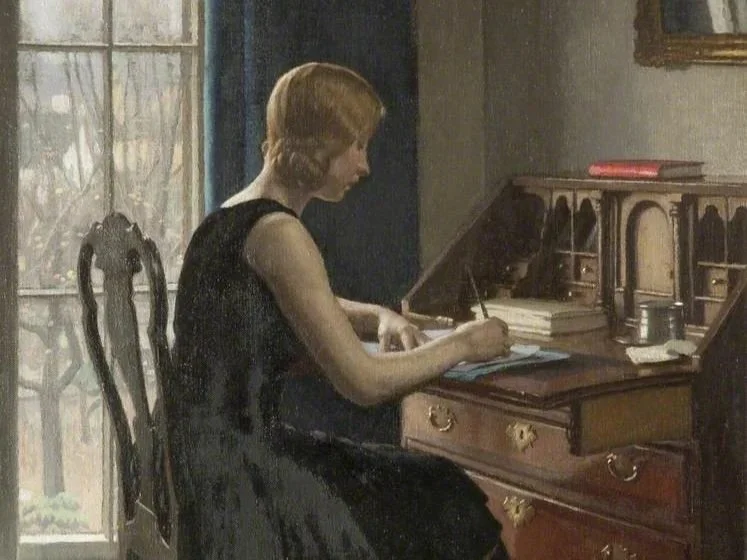
Harold Knight, Girl Writing, 1931.
Written and published by Abbey Fedora (Department of English, Theatre, Film & Media), UMIH Undergraduate Intern.
“Celebration and loss are not opposed,” replied Dr. Neil Besner when asked why grief is juxtaposed with joy in poems about loss. Dr. Neil Besner joined us at the University to share his talk “Silence, Loss, Love, and the Lone Voice: The Poetry of Grief,” organized by the University of Manitoba Institute for the Humanities (UMIH) Research Cluster Poetry, Grief, and Mourning. Besner’s response that “both things are true,” grief and joy, greatly represented his message about the role that creative expression plays in moments of grief and loss.
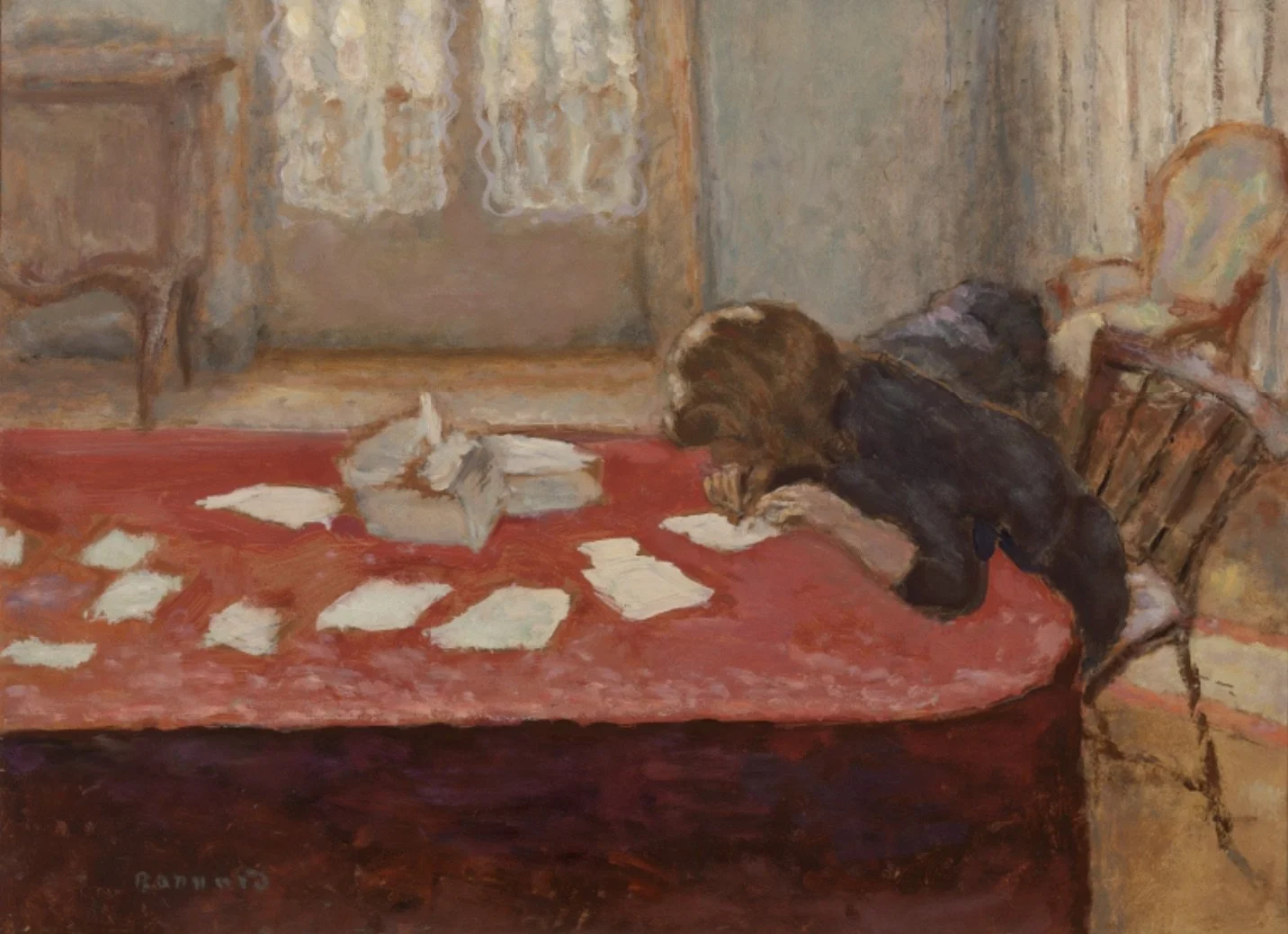
A young woman in all black engaging in writing from Pierre Bonnard’s painting Young Woman Writing (1908).
On October 6th, 2026, many eagerly gathered to hear Besner share his thoughts on poetic explorations of grief. Before diving into various poems on loss, Besner shared a piece of his own life with the audience to demonstrate the intimacy of words on a page; Besner discussed a ritual of reading poetry to his wife, where she has one rule: he is not allowed to disclose information about the poem. Rather than taking the position of a literary critic, which Besner so often did in his years of scholarly experience, Besner simply reads. Besner explained that to assume the role of critic would be to violate the “intimacy of the living space,” as his job is to deliver the words as they are rather than critique them. His submission to the words suggests the importance inherent in written expression.

Karin Jurick’s painting Art Lovers which depicts two people engaging in shared reading.
Themes of silence and expression pervade poems about loss, as Besner explores. The first poem that Besner read was Elizabeth Bishop’s “One Art.” Besner prefaced that Bishop’s life was abundant with loss, including the institutionalization of her mother and the later death of her partner, Lota. While Bishop’s poem explicitly addresses feelings of lack, evident in the speaker’s repeated use of the term “lost” and the poem’s wandering tone, the poem’s final stanza, which Besner paid close attention to, moves from speaking about loss to confronting it. Discussing this stanza, Besner claimed that Bishop’s emphasis on the importance of writing “couldn’t be clearer,” as she, in a parenthetical fashion, writes “(Write it!)” in the final line (19). Besner noted that this interjection suggests that Bishop has “forced herself to write” as a response to her grief, and further, argued that the entire poem may be “included in the command.” Besner poses the important question: who is this command for? Besner argued that it is for Bishop herself, framing the poem, and the act of writing, as a means of expression and healing in processes of grief. Recalling Besner’s readings of poetry to his wife, Bishop’s emphasis on writing about loss further demonstrates the role that written expression plays in the maintenance and understanding of intimate relationships, a key idea in Besner’s talk.
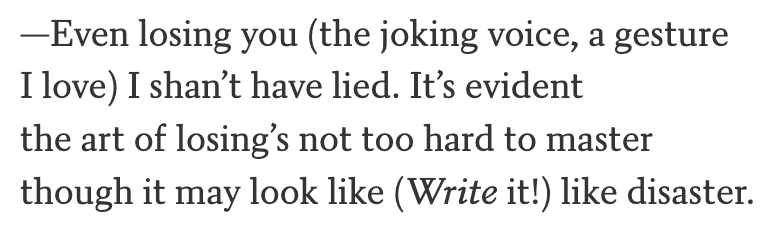
The final stanza of Bishop’s “One Art” where the speaker emphasizes the importance of written expression.
Besner explored multiple other poems about loss in comparison to Bishop’s, including William Carlos William’s “Danse Russe,” W.H Auden’s “In Memory of W.B. Yeats,” and Irving Layton’s “Keine Lazarovitch 1870-1959,” before moving to the words of a local poet, Dennis Cooley. Dennis Cooley’s elegy, a form intended to lament the deceased, titled Irene is dedicated to his mother, written after her passing. Besner mentioned a critical quote from Cooley’s book behind the reasoning of its creation, where Cooley explains he wanted his mother to exist beyond mere memory. Cooley’s suggestion that writing transforms memories into something concrete greatly resonates with Bishop’s sentiment of forcing herself to write amidst her grief. Besner’s comparison of Bishop’s command with Cooley’s intention highlights writing as an active act rather than a passive one, one that sets healing into motion. Similarly, Besner described Cooley’s elegy as being “plotted in motion,” both in terms of Cooley’s use of repetition throughout the poem as well as its purpose of immortalizing his mother. Besner elaborated that Cooley’s poem showcases “the sounds of thinking as he thinks,” characterized by uncapitalized letters and occasional blank spaces, suggesting that Cooley uses poetry to work through difficult emotions, positing it as a productive practice. Thus, similar to his argument that Bishop’s poem frames writing as an act of healing, Besner suggests that Cooley’s elegy shows how poetry is used to navigate experiences of loss, and further, how it creates something positive. When asked about Cooley’s choice to memorialize his mother through poetry, Besner responded that the useage of pain to write results in “something blended,” reiterating that poetry is a transformative medium.
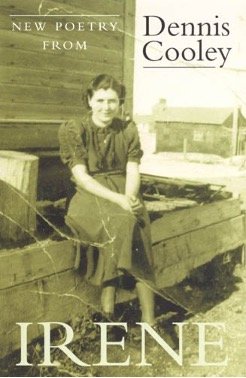
The cover of Dennis Cooley’s elegy Irene.
Before ending his talk, Besner decided to close with a song. Grabbing his guitar, Besner performed James Taylor’s “Fire and Rain” to a room of attentive ears, prefacing by saying he believes the song’s lyrics support his argument about loss and writing; a reflection upon loss and reminiscence, Taylor’s song provides a fitting close to the words of Bishop and Cooley. Whether through song, writing, or recited poetry, Besner demonstrates the power of words and expression in understanding and conveying emotions, specifically those related to grief. Some of Besner’s final words during the question period were that he believes he has “not yet” found his voice. While he may believe he hasn’t “found it yet,” Besner held the attention of all those in attendance during both his speech and his song.
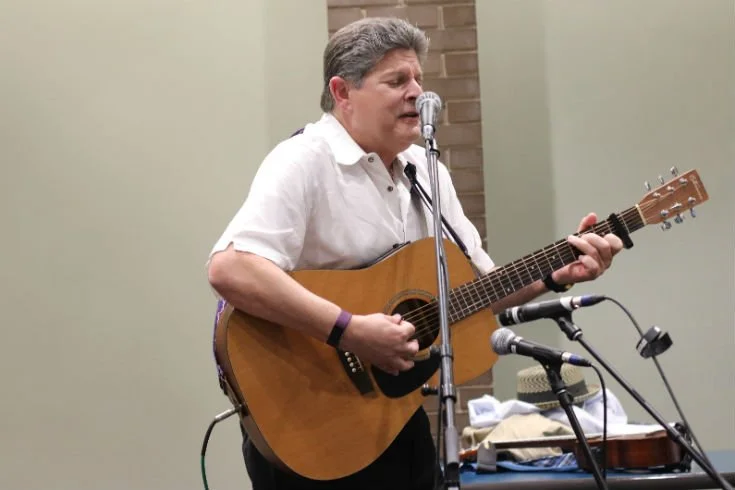
Dr. Neil Besner singing at his retirement party hosted by the University of Winnipeg.